Winter Garden Flocks: Follow One Bird Without Losing the Group
Several species may move through a garden together. Record the group context, then identify individual birds from their own field marks rather than assigning the first familiar name to the entire flock.
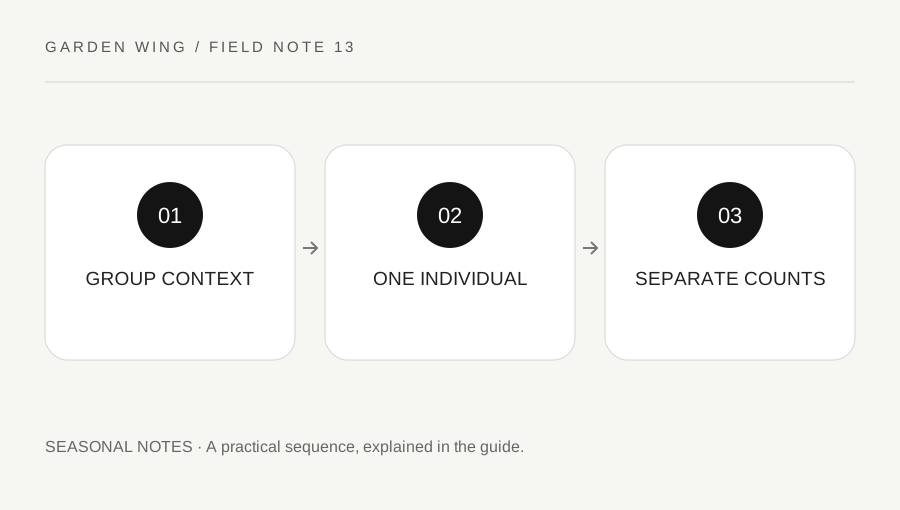
Original explanatory diagram. Numerical examples in this guide illustrate the reasoning; they are not a claim of hands-on testing.
Describe the movement before the names
A winter group may pass through trees, work along a hedge or gather briefly around a food source. Note its route and approximate duration from a settled position. “Small birds moved from birch to hedge over three minutes” is a useful record even when the species list remains incomplete.
The word flock describes an observed grouping, not proof of a permanent association or a single species. Avoid assuming that every bird traveling with an identified tit, chickadee or finch shares its identity. Watch one individual while retaining enough awareness of the group to notice a new shape or behavior.
Winter conditions can reduce visibility through short daylight, low sun and poor weather. Record those limits. A brief clear side view may be more informative than several distant silhouettes against a bright sky.
Choose one bird and collect independent features
Follow a single bird only while you can do so reliably. Record head pattern, bill, wing markings, tail and size relative to a nearby bird at similar distance. When it disappears and another enters the view, reset the description rather than attaching the new bird's wing pattern to the previous bird's head.
In a UK garden, compare Blue Tit and Great Tit references if both are plausible. In a US garden, check the appropriate local chickadee and other small woodland species rather than assuming the small shortlist covers the entire region. Country-level filtering is only a starting point.
Use tentative labels for partial views. “Two small birds unidentified, one confirmed Great Tit” preserves the evidence more accurately than converting the entire moving group into three Great Tits because the first bird was recognizable.
Count what the view supports
Moving groups are difficult to count because individuals vanish behind branches and reappear. Record a minimum clearly observed number or an explicitly marked estimate according to your purpose. Do not give an exact total if the group was never visible together.
For an informal maximum-simultaneous log, keep each species' greatest number seen at once. A separate group note can describe the mixed movement without adding uncertain individuals to the species totals. If you join a formal winter survey, follow its method rather than importing this private-log approach automatically.
An illustrative entry might read “at least six small birds in moving group; two Blue Tits simultaneously confirmed; remaining birds unresolved.” The uncertainty is not a defect to hide. It tells a later reader how much of the group was actually identified.
Compare later sessions without inventing residency
A group present one morning and absent the next may simply be using a different route or appearing outside the watched period. Write “not observed during this session” rather than “left the area.” Repeated winter watches can show how your patch is used, but a window view cannot track every movement in the neighborhood.
Review whether the same part of the garden repeatedly offers the clearest views. You can choose a comfortable observation position for the next session without approaching birds or changing their food supply to produce a repeat performance.
Finish with one identification question from the group, such as the head pattern of a small bird that moved differently from the others. Study that comparison privately between sessions. Learning one uncertain member well is more useful than claiming a long winter flock list assembled from a few matching colors and incomplete glimpses.
A practical checklist
Tick items for your own use. This checklist is saved only in this browser.
Questions that come up
Does a flock contain only one species?
No. Mixed-species groups occur, so each bird still needs its own evidence. Shared movement does not establish shared identity.
Should I add every reappearance to the count?
No. That can count the same bird repeatedly. Use a clearly stated method and mark the limits of the view.
Can I predict exactly when the flock returns?
A personal observation pattern is not a timetable. Weather, food and movements vary, so treat any repeated timing as a question to observe.
References & scope
Background references checked on 18 October 2026. The examples and practice exercises are original editorial explanations, not copied procedures or professional advice.
- Cornell Lab: All About Birds identification guide
- Cornell Lab: bird feeder cleaning
- RSPB: bird identification guide
- RSPB: current garden bird health guidance
- RSPB: current feeding advice
- Cornell Lab: American Robin
- RSPB: Robin
- RSPB: Blackbird
- American Birding Association: Code of Birding Ethics
- RSPB: bird-bath guidance
- Cornell Lab: preventing bird-window collisions
- BTO: identification resources
- RSPB: Starling
- Cornell Lab: finding a baby bird
- RSPB: injured birds and local help