UK Garden Comparison: Blackbird or Starling?
A dark bird on the lawn can suggest either species to a beginner. Compare tail, body proportions, bill and plumage stage rather than treating “black” as a complete identification.
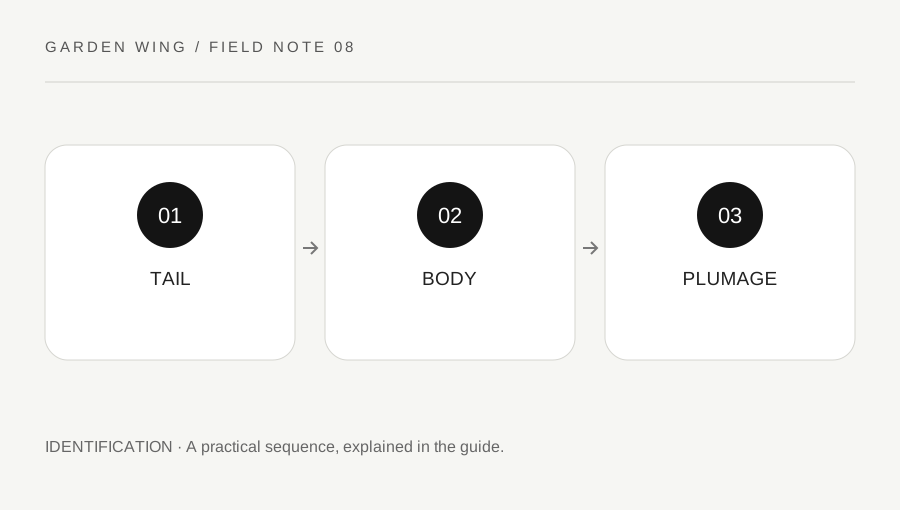
Original explanatory diagram. Numerical examples in this guide illustrate the reasoning; they are not a claim of hands-on testing.
Begin with proportions on the ground
Watch from a position where the bird continues its ordinary activity. A Common Blackbird has a thrush shape with a relatively long tail. A European Starling is more compact and short-tailed, with a pointed bill and pointed wings especially apparent in flight. These are comparison clues rather than a guarantee from one fleeting outline.
Write what you can see before opening a reference. For example, “dark medium bird, long tail held behind body, paused between movements” preserves a useful structure. “Blackbird because it was black” does not tell you whether any distinguishing feature was observed.
Angle matters: a tail pointing directly away can look shorter. If the bird turns, compare the side view without moving closer. Keep the size estimate broad unless a known object or familiar bird is genuinely at the same distance.
Check sex and age before using color
An adult male Blackbird is dark, while a female is brown and a juvenile can show a more mottled appearance. A Starling's appearance also changes with age and season; a juvenile can be brown rather than the dark glossy adult a beginner expects. Reference pages showing only one adult image can therefore be misleading.
Use the linked RSPB Blackbird page and a complete regional Starling reference. Compare the bill, head, tail and surface pattern in addition to color. A pale-spotted dark bird can direct attention toward a Starling comparison, but glare, distance and a partial view can hide or exaggerate spots.
Do not reverse-engineer a confident label from one matching detail. Ask whether the remaining visible features agree and which expected feature was not seen. An unseen mark is not the same as a clearly absent mark.
Use activity without making it exclusive
Both species can use garden lawns, so location alone does not settle the comparison. Note the movement and whether several birds are present together. A gathering of starlings can be a helpful context, but a solitary Starling is still possible and a Blackbird need not always be alone.
For a worked note, write “three short-tailed dark birds walking close together on lawn; pale speckling visible on one; pointed bills.” That collection supports a Starling comparison better than the word dark alone. A different note, “one thrush-shaped bird with long tail and brown body, partly hidden beneath hedge,” should send you back to a broader reference set rather than forcing a male-Blackbird image onto the observation.
Separate each observed individual when their appearances differ. Do not assume every bird in the same group belongs to the same species.
Record the conclusion at the supported level
After comparing references, choose confirmed only if the evidence is sufficient for your experience and purpose. Otherwise keep “Blackbird candidate” or “Starling candidate” with the field marks. A private learning log can preserve uncertainty without needing to fill a formal species field.
Plan one follow-up feature, such as a clear tail profile or the pattern on the head and chest. A second normal garden watch is often more useful than repeatedly pursuing the original bird. If the candidate still fails several features, widen the comparison beyond these two species.
This article teaches one UK comparison, not a claim that every dark garden bird must be one of the pair. Unusual visitors, other species and poor viewing conditions remain possible. A good result can be a better description and a narrower question rather than a final name attached to insufficient evidence.
A practical checklist
Tick items for your own use. This checklist is saved only in this browser.
Questions that come up
Is every black garden bird a Blackbird?
No. Color alone is insufficient, and several species can appear dark. Compare structure, pattern, behavior and regional occurrence.
Can a brown bird be a Starling?
Yes. Juvenile starlings can be brown. Use a reference covering age-related plumages rather than only a dark adult image.
Does one bird feeding alone rule out Starling?
No. Group behavior is supporting context, not an absolute identification rule. A single individual still needs its own field-mark comparison.
References & scope
Background references checked on 18 October 2026. The examples and practice exercises are original editorial explanations, not copied procedures or professional advice.
- Cornell Lab: All About Birds identification guide
- Cornell Lab: bird feeder cleaning
- RSPB: bird identification guide
- RSPB: current garden bird health guidance
- RSPB: current feeding advice
- Cornell Lab: American Robin
- RSPB: Robin
- RSPB: Blackbird
- American Birding Association: Code of Birding Ethics
- RSPB: bird-bath guidance
- Cornell Lab: preventing bird-window collisions
- BTO: identification resources
- RSPB: Starling
- Cornell Lab: finding a baby bird
- RSPB: injured birds and local help