Avoid Double Counting During an Informal Garden Watch
Visits, individuals and simultaneous counts are different measurements. Decide what you are recording before the first bird moves between the hedge and the feeder.
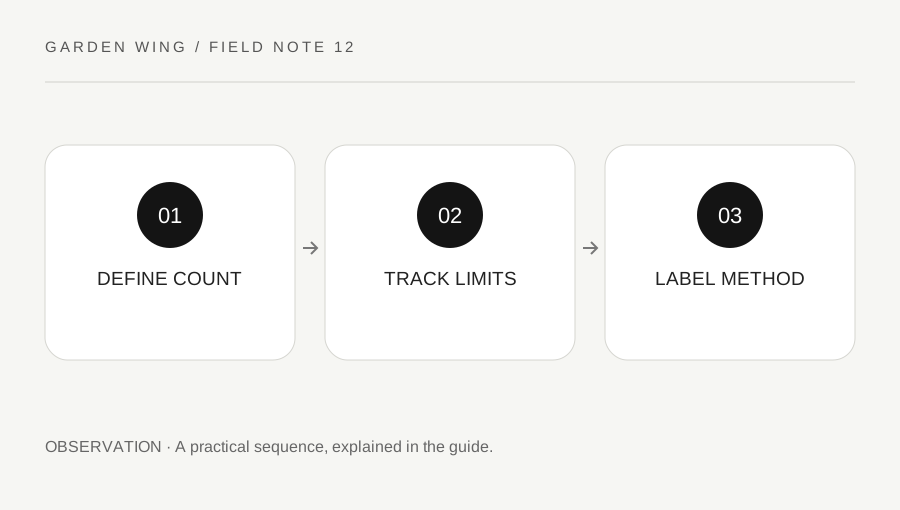
Original explanatory diagram. Numerical examples in this guide illustrate the reasoning; they are not a claim of hands-on testing.
Choose a counting question
You might want to record how many birds are visible at once, how many feeding visits occur, or which species appear during a session. Those are different questions and need different columns. One bird making six trips produces six visits but does not prove six individuals.
For an informal beginner log, the largest number of a species seen simultaneously can be a manageable measure. Label it explicitly. It is not an estimate of the total population using the garden and should not be presented as one.
If you take part in a formal count, use its current instructions. Projects can differ in whether they include flyovers, how they define the observation area and how they treat birds that briefly leave. Your private method does not override those rules, even if it sounds similar to a familiar survey.
Use a fixed patch and session boundary
Describe what is inside the watched area. A bird on a neighboring roof may be visible but outside a project boundary. In a private log you can record it separately, provided the distinction remains clear. Keep session start and end times so that a later arrival is not silently added to an earlier session.
Write a count when you see several birds together rather than adding every movement. If three sparrows are visible under the hedge and one moves to the feeder, the simultaneous count remains three if you can confidently track it. If you lose track, do not invent an identity to make the arithmetic convenient.
For a moving flock, record an estimate only when appropriate and mark it as estimated. An exact-looking number copied from a hurried impression can imply precision the view did not support.
Keep visits in a separate measure
Suppose one robin candidate visits a fence at 09:02, 09:04 and 09:07. You can record three observed visits or appearances, but you cannot establish whether all were the same individual without sufficient distinguishing evidence. Write “three appearances, identity not established” rather than asserting one resident or three birds.
If your question concerns feeder activity, define what counts as a visit. Does moving between two ports begin another visit, or only leaving and returning? There is no need to invent a universal research definition for a private exercise, but the chosen rule should remain stable during the comparison.
Keep species uncertainty separate from count uncertainty. “Two unidentified small birds together” is a usable observation. Changing them to a familiar species just to fill the count table creates a different error from double counting.
Review a worked session before comparing days
Imagine a ten-minute watch: two sparrows appear together, later three appear together, and one returns alone several times. The maximum simultaneous sparrow count is three. The visit total would require a separately defined event record; it cannot be reconstructed reliably just by adding those brief notes.
On another day, a five-minute watch with one sparrow does not directly show a decline from three to one. Effort, time of day, visibility and movement differ. Record those conditions before comparing. A personal log can reveal questions worth investigating without proving a population trend.
At the end, write the method in one sentence beside the result. “Maximum seen together during ten minutes from kitchen window” communicates much more than “sparrows: three.” Clear methods let you improve future observations and prevent an attractive chart from turning different measures into an apparent pattern.
A practical checklist
Tick items for your own use. This checklist is saved only in this browser.
Questions that come up
Does a bird returning count as another individual?
Not automatically. A return is another appearance or visit, but identity may be unknown. Keep the measure explicit.
Can I use these rules for every citizen-science project?
No. Read and follow the particular project’s current protocol, including boundaries, duration and flyover rules.
Is maximum simultaneous count the whole garden population?
No. It is a conservative session measure of birds observed together, not a census of every individual using the area.
References & scope
Background references checked on 18 October 2026. The examples and practice exercises are original editorial explanations, not copied procedures or professional advice.
- Cornell Lab: All About Birds identification guide
- Cornell Lab: bird feeder cleaning
- RSPB: bird identification guide
- RSPB: current garden bird health guidance
- RSPB: current feeding advice
- Cornell Lab: American Robin
- RSPB: Robin
- RSPB: Blackbird
- American Birding Association: Code of Birding Ethics
- RSPB: bird-bath guidance
- Cornell Lab: preventing bird-window collisions
- BTO: identification resources
- RSPB: Starling
- Cornell Lab: finding a baby bird
- RSPB: injured birds and local help