Keep a Seasonal Bird Notebook Without Overstating the Pattern
A notebook can reveal changes in your own garden view. Keep effort and uncertainty visible so that a quiet week, a new visitor and a missed observation do not become the same kind of evidence.
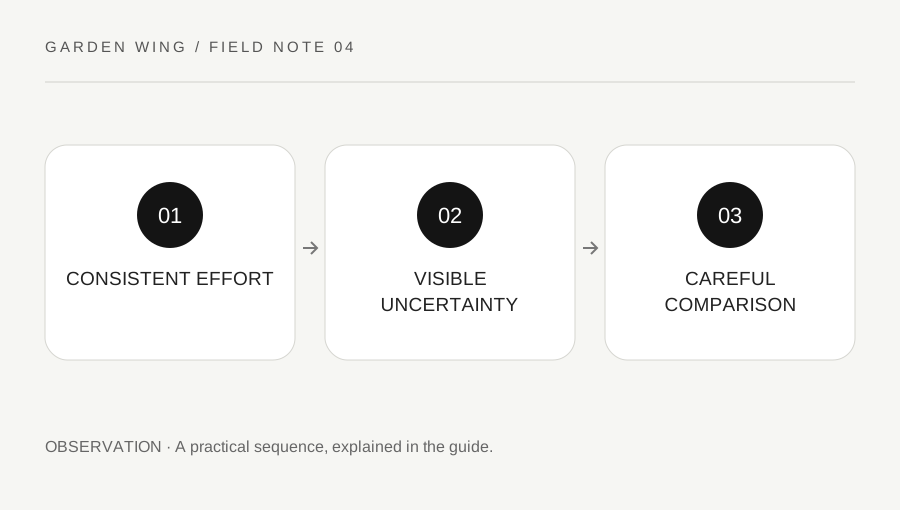
Original explanatory diagram. Numerical examples in this guide illustrate the reasoning; they are not a claim of hands-on testing.
Define the patch and the effort
Describe the observation area in ordinary words: the front hedge and lawn visible from the kitchen, or the back garden from a fixed bench. Note areas you cannot see. If a fence or growing shrub blocks part of the view later, record that change. Your observations describe the watched patch, not necessarily every bird present nearby.
Choose a manageable routine and write the actual time spent watching. Three ten-minute sessions and one casual glance are different amounts of effort. A blank date means no record unless you explicitly watched and saw no birds. Keeping “not watched” separate from “watched, none observed” prevents a common error when turning a notebook into a seasonal chart.
Use a few dependable fields
For each session, record date, approximate start time, duration, weather, visibility, species or uncertain description, and the counting method. Add a short behavior note only when useful. You do not need a complicated form with dozens of empty boxes. A consistent small set is easier to maintain and compare.
Keep the location coarse if exporting or sharing notes, especially where a nest or sensitive bird might be involved. The browser tool saves notes only on this device and lets you export them, but it is not a conservation database. If you contribute to a citizen-science project, enter your observations through its official system and follow that project's location, effort and identification instructions.
Separate seasonal appearance from detection
A bird first noticed in March may have arrived recently, become more visible or simply escaped earlier attention. Write “first observed this year” rather than “arrived today” unless you have evidence for arrival. Similarly, an absence from the notebook does not prove that a bird has left the wider area.
Compare similar sessions where practical. A dawn watch and a noisy midday watch may reveal different activity even in the same week. Changes in leaf cover, garden work and weather can affect visibility. Add these conditions beside the count so that later interpretation remains grounded in what the notebook actually recorded. A precise date is useful, but it does not by itself establish a cause.
Build a small comparison that can be explained
Imagine four weekly sessions of ten minutes from the same window. You observe one robin candidate in three sessions and none in the fourth. Your supported statement is “a robin candidate was observed in three of four sessions.” You cannot conclude that the garden contains exactly one robin, that it was absent all week during the fourth session, or that a population is increasing.
Keep identification uncertainty consistent. If you later confirm a candidate from a clear field mark, add a note explaining the new evidence rather than silently rewriting every earlier uncertain sighting. Corrections are part of a useful record. Mark the original description and the reason for revision so that you can distinguish what was known at the time from what was inferred later.
Review the notebook for the next useful question
At the end of a month, choose one practical question: which parts of the garden were used most often during the watched sessions, which field marks remain confusing, or whether a different viewing angle would improve a recurring blind spot. These questions guide better observation without claiming that a home notebook is a controlled ecological study.
Export or back up the log periodically if you want to retain it. Browser storage can be cleared and is not synchronized automatically between devices. Review any notes before sharing them to remove precise locations or personal details. A small, well-described dataset can be valuable for personal learning; its usefulness comes from honest methods and clear limits rather than the number of rows collected.
A practical checklist
Tick items for your own use. This checklist is saved only in this browser.
Questions that come up
Can a garden notebook prove a species is declining?
A personal notebook alone usually cannot establish a population trend. Detection, effort and local conditions vary. Formal monitoring projects combine defined methods with broader data.
Should I overwrite a mistaken identification?
Keep a correction note with the reason for the change. Preserving the evidence makes your record easier to interpret later.
Is browser storage a permanent backup?
No. It can be cleared or become unavailable. Export notes you want to retain and keep the file in a location you control.
References & scope
Background references checked on 18 October 2026. The examples and practice exercises are original editorial explanations, not copied procedures or professional advice.
- Cornell Lab: All About Birds identification guide
- Cornell Lab: bird feeder cleaning
- RSPB: bird identification guide
- RSPB: current garden bird health guidance
- RSPB: current feeding advice
- Cornell Lab: American Robin
- RSPB: Robin
- RSPB: Blackbird
- American Birding Association: Code of Birding Ethics
- RSPB: bird-bath guidance
- Cornell Lab: preventing bird-window collisions
- BTO: identification resources
- RSPB: Starling
- Cornell Lab: finding a baby bird
- RSPB: injured birds and local help