A Young Bird in the Garden: Observe From a Distance First
A young bird outside a visible nest can prompt concern. Keep people and pets away, avoid assuming abandonment, and seek local wildlife guidance when the situation may require help.
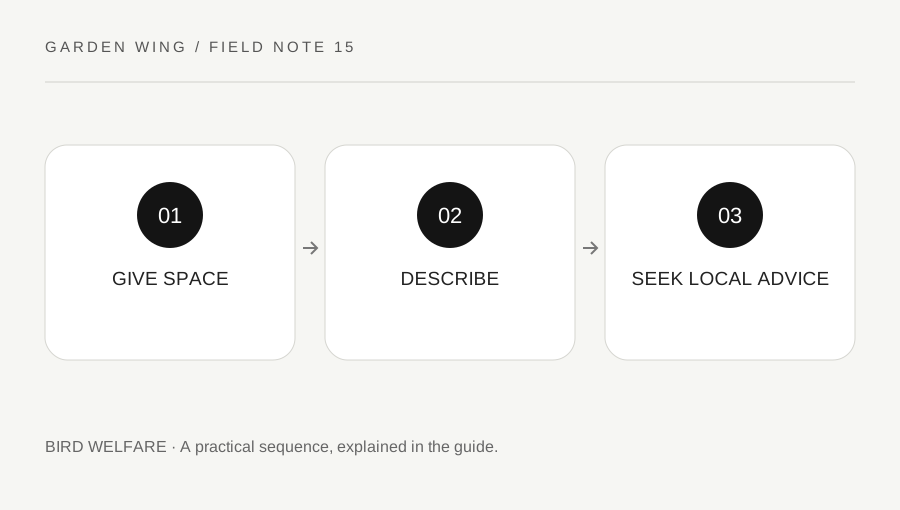
Original explanatory diagram. Numerical examples in this guide illustrate the reasoning; they are not a claim of hands-on testing.
Reduce immediate disturbance before interpreting
Stop repeated approaches and keep pets and other people away from the area. Watch from a distance or indoors if possible. A bird's behavior can change when a person stands nearby, so close attention may conceal rather than reveal whether an adult is attending it.
Write the observable situation: feather coverage, posture, movement, visible injury and the broad setting. Do not estimate an exact age in days from a brief view. Young birds differ by species, and an online image comparison cannot reliably establish their needs.
This guide is about observation and deciding where to seek advice, not handling or treatment. If there is a clear immediate hazard, visible injury or another urgent welfare concern, contact a local qualified wildlife rehabilitator or appropriate wildlife authority for instructions rather than relying on a generalized internet rule.
Keep “alone” separate from “abandoned”
A young bird visible without an adult is alone in your current view. That is not the same as being abandoned. An adult may be out of sight, collecting food or avoiding the observer. Record how long and from where you watched, but do not use a short arbitrary countdown as proof that intervention is necessary.
Some young birds normally spend time outside the nest while adults continue care. Species and developmental stage matter, so use a reliable local source when deciding what the observation means. A bird that seems awkward is not automatically injured; equally, unusual behavior should not be dismissed without appropriate advice.
If you seek help, provide a concise description and broad location privately to the professional or authority. Follow its directions about any additional details needed. Avoid a public post that draws people to the vulnerable bird.
Do not improvise food or water treatment
Avoid offering food, putting liquid into the beak or attempting a treatment based on a guessed species. A plausible-looking household option may be unsuitable, and handling can create additional problems. Ask the local wildlife professional what, if anything, you should do while waiting for help.
Keep the notebook descriptive: “young bird moved beneath shrub; adult not observed from window” is more useful than “starving abandoned chick.” The latter bundles several unsupported conclusions together and can make it harder to communicate the actual evidence.
If an adult approaches while you are watching, let the interaction proceed without moving closer. A return visit can be recorded as an observation, but it does not require you to inspect the young bird afterward. Maintain space and minimize the number of people monitoring it.
Separate the welfare decision from the species lesson
Once any immediate concern has been addressed through appropriate local guidance, you can review the field marks privately. Compare juvenile appearances in a regional reference, keeping the identification tentative if the view was incomplete. Do not delay seeking help for an injured bird merely to complete a species name first.
For a worked communication example, use “small feathered bird under garden shrub, walking but not flying during a brief distant watch, no obvious blood, cat kept indoors” rather than a diagnosis. The recipient can ask the questions needed for its local process.
Finish by recording the advice source and action taken without publishing sensitive details. A useful outcome may be leaving the bird undisturbed, or following specific professional instructions. The correct choice depends on the real situation and local expertise, not on whether a website can supply a confident label from a few descriptive words.
A practical checklist
Tick items for your own use. This checklist is saved only in this browser.
Questions that come up
Does being outside a nest mean the bird needs rescue?
Not necessarily. Developmental stage and species matter. Watch from a distance and consult local wildlife guidance when uncertain or when injury or danger is present.
Should I give it water in its beak?
Do not improvise feeding or liquid treatment. Obtain instructions from a qualified local wildlife professional.
Must I identify the species before seeking help?
No. A clear description and location can start the conversation. Do not delay an urgent welfare contact while trying to name the bird.
References & scope
Background references checked on 18 October 2026. The examples and practice exercises are original editorial explanations, not copied procedures or professional advice.
- Cornell Lab: All About Birds identification guide
- Cornell Lab: bird feeder cleaning
- RSPB: bird identification guide
- RSPB: current garden bird health guidance
- RSPB: current feeding advice
- Cornell Lab: American Robin
- RSPB: Robin
- RSPB: Blackbird
- American Birding Association: Code of Birding Ethics
- RSPB: bird-bath guidance
- Cornell Lab: preventing bird-window collisions
- BTO: identification resources
- RSPB: Starling
- Cornell Lab: finding a baby bird
- RSPB: injured birds and local help