An Autumn Visitor: What Your Garden Record Can and Cannot Show
A bird newly noticed in autumn may be passing through, moving locally or becoming easier to detect. Keep the sighting clear without inventing an origin or migration journey.
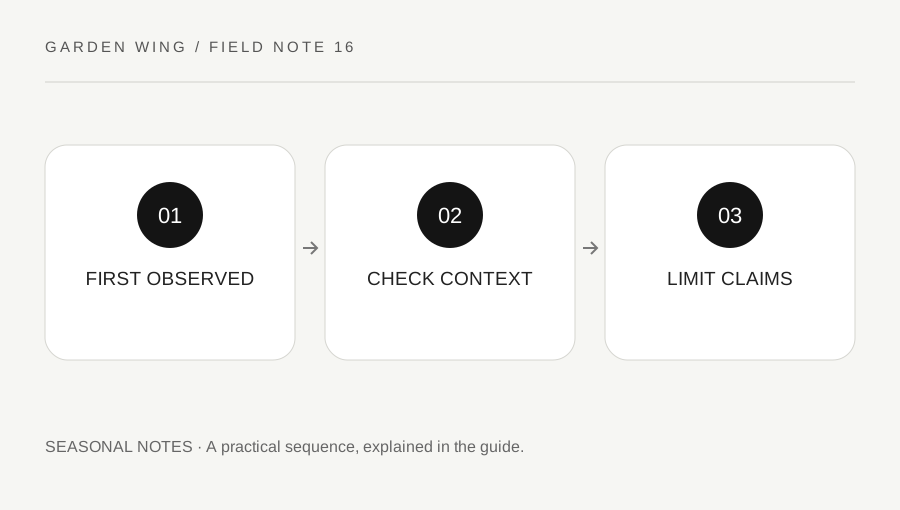
Original explanatory diagram. Numerical examples in this guide illustrate the reasoning; they are not a claim of hands-on testing.
Use first observed rather than first arrived
A new name in the notebook records a first observation, not necessarily the bird's first day in the area. It may have been present during unwatched hours or hidden by foliage. Write the date and effort so that the meaning remains clear.
Autumn activity can change as food, weather and daylight change, but one garden encounter does not establish the cause. Describe what happened: a group entered a tree, fed briefly and left toward the neighboring hedge. The note can stand without a story about a long-distance journey.
If the identification is unfamiliar, compare structure, plumage and range carefully. Seasonal or immature appearances can make a local species seem new. A candidate that resembles a dramatic migrant in one photograph still needs the same multiple-feature check as a familiar garden bird.
Check the regional and seasonal reference
Use a source that shows occurrence for the actual area and time of year. The country-level finder is too coarse to establish a local migration claim. A bird occurring somewhere in the United States or United Kingdom may not normally occur in your particular patch.
Read whether the reference describes resident populations, seasonal movements or variation across regions. Do not convert a broad seasonal pattern into a prediction for a particular date in your garden. Weather and individual movement can differ, and a range map is a summary rather than a live tracking record.
Keep the source link and the specific feature that supported your comparison. If the candidate would be unusual locally, seek an appropriate review route before sharing a confident claim. Preserve the original field notes rather than rewriting them to fit the exciting possibility.
Record movement without inventing a destination
A bird flying west from the garden was observed moving west at that moment. It does not prove a westward migration route, its departure point or its final destination. Short movements between feeding or resting places can resemble a directional departure from a small viewing patch.
If a flock passes overhead too briefly to identify, record a broad description and a clearly marked count estimate. Do not attach the nearest plausible species name simply because a migration calendar lists it. A sound heard at the same time may help, but only if the association is reliable.
An illustrative entry might read “eight or more medium birds crossed above patch toward west; wing detail unclear; not included in confirmed species totals.” This preserves the event while separating movement, count and identification uncertainties.
Compare the season across consistent watches
Review the number of watched sessions and their duration before comparing autumns. A year with twice the observation effort can produce more species records without any ecological change. Leaf cover, weather and a new viewing position also affect detection.
Summarize at the scale your record supports: “observed during two October watches” or “not recorded in last year's limited sessions.” Avoid “now absent from the region” or “migration delayed” from a personal notebook alone. Those claims need broader data and suitable methods.
Finish with one question for the next watch, perhaps whether a field mark was seasonal or whether the species repeatedly uses one tree. A careful autumn record can be interesting without a dramatic origin story. Its lasting value comes from observable details, a clear method and the willingness to leave a possible migrant as a candidate when the evidence is incomplete.
A practical checklist
Tick items for your own use. This checklist is saved only in this browser.
Questions that come up
Does a westbound bird prove migration?
No. The direction describes one observed movement. It does not establish the purpose, origin or destination of the journey.
Can an autumn bird be a resident I missed earlier?
Yes. Detection and appearance change. Check the full regional reference before assuming a newly observed bird is a migrant.
Can I claim a trend from two autumn records?
Not reliably. Effort and conditions vary, and a garden notebook alone does not establish a regional migration trend.
References & scope
Background references checked on 18 October 2026. The examples and practice exercises are original editorial explanations, not copied procedures or professional advice.
- Cornell Lab: All About Birds identification guide
- Cornell Lab: bird feeder cleaning
- RSPB: bird identification guide
- RSPB: current garden bird health guidance
- RSPB: current feeding advice
- Cornell Lab: American Robin
- RSPB: Robin
- RSPB: Blackbird
- American Birding Association: Code of Birding Ethics
- RSPB: bird-bath guidance
- Cornell Lab: preventing bird-window collisions
- BTO: identification resources
- RSPB: Starling
- Cornell Lab: finding a baby bird
- RSPB: injured birds and local help