Your First Backyard Bird Session: Observe Before Naming
You do not need to identify every bird to begin. A repeatable ten-minute watch and a few precise notes create a better foundation than a long list of hurried guesses.
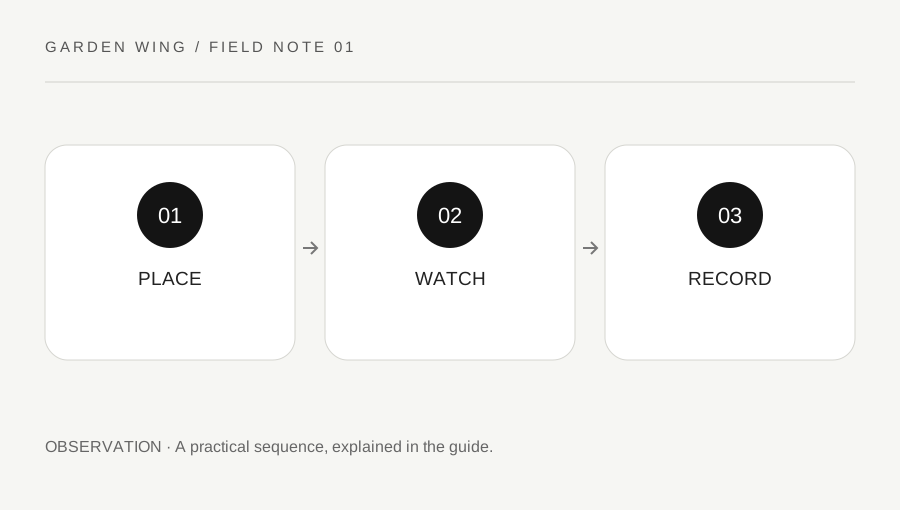
Original explanatory diagram. Numerical examples in this guide illustrate the reasoning; they are not a claim of hands-on testing.
Choose a comfortable, repeatable position
Start at a window or another quiet place where you can watch without approaching the birds. Note the part of the garden you can actually see: lawn, fence, hedge, tree canopy or feeder. A view of one small hedge is a perfectly valid starting patch. You are learning that patch, not conducting a complete survey of the neighborhood.
Choose a manageable duration, such as ten minutes, and record the start and finish times. The duration is an organizing choice rather than a scientific standard. Leave pets indoors or away from the viewing area where possible. Set your notebook within reach so that searching for it does not interrupt the observation. If you use binoculars, practice finding a fixed garden object first.
Write down what you saw, not what you hoped
Begin with shape and behavior: sparrow-sized, rounded body, short stout bill, feeding on the ground. Add a clearly visible color patch and its location, such as a pale wing bar or dark head. “Small brown bird” is a start, but “small brown bird with a thick bill, hopping under the hedge” creates a more useful comparison.
Separate observation from interpretation. “Three birds visible together at 09:12” is an observation. “The same three live here all year” is a conclusion that the single watch cannot establish. You can write a possible name followed by a question mark, but keep the descriptive evidence. A blank species field is more honest and more useful than a confident unsupported label.
Use a regional shortlist carefully
Select the United States or United Kingdom in the candidate finder, then enter broad size, visible color and setting. The tool contains only sixteen selected common birds, with some species represented in both regions. It does not include all local birds, seasonal visitors or every plumage stage. A missing candidate means “not in this small shortlist,” not “the bird cannot occur here.”
Open a candidate's reference page and compare more than one field mark. Check the range map and seasonal information for your actual location. The American Robin and the European Robin share a familiar English name but are different species. Country names and local common names can mislead, so keep the reference link with a tentative identification when learning.
Count without turning movement into extra birds
For an informal garden log, record the largest number of a species seen at once during the session, and describe that counting method. A bird that leaves a feeder and returns five times is not automatically five individuals. You can separately note repeated visits if behavior is your interest, but do not mix visit counts with simultaneous bird counts.
If you later join a formal survey, follow that project's instructions rather than transferring this method automatically. Survey protocols differ in duration, area and treatment of flyovers. In an example session, you might write “two House Sparrows simultaneously beneath hedge; one unidentified small bird overhead.” This preserves uncertainty and avoids inflating a species count by assigning an uncertain flying bird to a familiar name.
Review one question after the watch
At the end, choose one uncertainty to investigate. Perhaps the unknown bird had a thin bill rather than the thick bill you expected. Read an appropriate regional guide and plan to look for that feature next time. Do not repeatedly move toward the bird to force a closer view. Better light or another quiet session may solve the question with less disturbance.
Keep the session date, approximate location, weather, duration and visibility alongside your bird notes. For a worked record: “18 October, ten-minute window watch, light rain, hedge partly obscured; two sparrows together; robin candidate, orange chest seen briefly.” These are illustrative notes, not reported sightings. Over several watches, this simple structure lets you compare what was observed under similar conditions.
A practical checklist
Tick items for your own use. This checklist is saved only in this browser.
Questions that come up
Do I need a feeder to begin?
No. Watch existing shrubs, trees, fences and open ground. Bird observation does not depend on supplying food, and feeding decisions need current local guidance.
Is a ten-minute watch enough?
It is enough for a manageable learning session, but it does not reveal every bird using the area. Use formal survey instructions when contributing to a particular project.
Should I include a bird I only heard?
You can record an unidentified sound as a separate observation. Do not assign a species unless you have sufficient evidence, and follow the rules of any survey you join.
References & scope
Background references checked on 18 October 2026. The examples and practice exercises are original editorial explanations, not copied procedures or professional advice.
- Cornell Lab: All About Birds identification guide
- Cornell Lab: bird feeder cleaning
- RSPB: bird identification guide
- RSPB: current garden bird health guidance
- RSPB: current feeding advice
- Cornell Lab: American Robin
- RSPB: Robin
- RSPB: Blackbird
- American Birding Association: Code of Birding Ethics
- RSPB: bird-bath guidance
- Cornell Lab: preventing bird-window collisions
- BTO: identification resources
- RSPB: Starling
- Cornell Lab: finding a baby bird
- RSPB: injured birds and local help