Use Binoculars in the Garden: Find, Focus and Follow
The first challenge is often getting the bird into view. Practice a repeatable finding and focusing sequence on a fixed object before using binoculars during a short bird encounter.
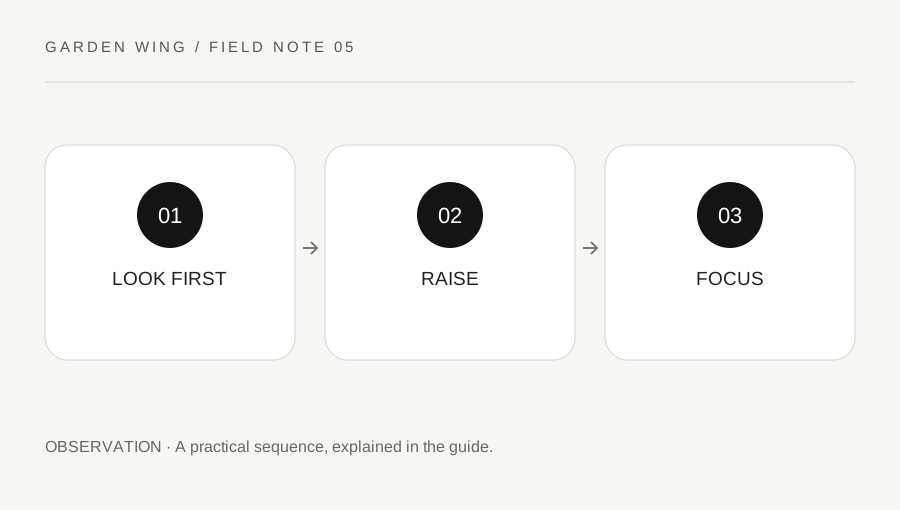
Original explanatory diagram. Numerical examples in this guide illustrate the reasoning; they are not a claim of hands-on testing.
Adjust the view before the bird arrives
Work in a safe stationary position and select a fixed object such as a fence corner or tree knot. Adjust the distance between the eyepieces until you see a single comfortable circle rather than two overlapping circles. If your binoculars have adjustable eyecups, use the manufacturer's instructions for viewing with or without glasses.
Check the manual for the diopter adjustment rather than turning every ring at once. Different designs use different controls, so a generic sequence may not fit your instrument. Once adjusted for your eyes, the main focus control should normally handle changing viewing distances. Avoid looking toward the sun or any intense light source. This is a practice guide for equipment you have, not a ranking of products to buy.
Keep your eyes on the target as you raise them
Find the object with your unaided eyes first. Keep looking at that spot and bring the binoculars to your eyes without tilting your head away. Many beginners look down at the binoculars, raise them and then search a large magnified scene from scratch. Keeping the visual target fixed makes the transition much easier.
Practice this several times on a stationary branch junction. Lower the binoculars, look at the junction, raise them and focus. If you miss, lower them and reset rather than sweeping randomly. A nearby landmark can help when a bird moves: “just above the fork, left side” is easier to relocate than an unstructured patch of leaves. Keep the practice brief and comfortable.
Focus on a feature you can describe
Once the bird is in view, turn the focus control gently until a useful feature is clear. Look for bill shape, head pattern, wing bars or tail shape rather than trying to inspect the entire bird at once. A brief view of one strong feature can be worth more than several seconds of unfocused magnification.
Nearby leaves can pull your attention away from a bird behind them. Try a small focus adjustment instead of assuming the bird itself is blurred. If the binoculars cannot focus at the close distance involved, use your unaided eyes and wait for another view. Do not move closer to a nest, roost or stressed bird just to overcome the instrument's focusing limits.
Follow movement without chasing
Watch the bird's direction and note the last clear landmark. If it disappears behind foliage, lower the binoculars and use the wider unaided view to relocate it. Rapidly panning a narrow magnified field can lose both the bird and your sense of its position. Moving your own body unnecessarily can also disturb the scene.
For a worked practice sequence, follow a bird from a fence to a hedge only while it remains easily visible from your position. Record the features you saw at the fence, then compare any new view from the hedge. If it leaves, let the encounter end. A useful record can contain “bill not seen” rather than turning every observation into a pursuit for a complete identification.
Build comfort into the routine
Rest your arms when needed and use a stable seated position if that helps. Keep straps and equipment clear of obstacles, and avoid walking while looking through the binoculars. If you experience eyestrain or an uncomfortable double view, stop and recheck adjustment using the manual. Persistent visual discomfort is not a challenge to overcome by forcing longer sessions.
After the watch, clean and store the instrument according to its instructions. Avoid rubbing grit into the lenses or applying household cleaners without checking suitability. Write down one skill to practice next time, such as finding a fixed target or adjusting focus smoothly. The goal is to gain a comfortable view with less disturbance, not to keep the binoculars raised continuously or to collect the longest possible list of birds.
A practical checklist
Tick items for your own use. This checklist is saved only in this browser.
Questions that come up
Should I keep the binoculars raised while searching the whole garden?
Not usually. The unaided view is wider and easier for locating movement. Raise the binoculars after you have found a target or a useful landmark.
Why do I see two circles?
The eyepiece spacing may not match your eyes, or the instrument may need adjustment. Consult its instructions and stop if the view remains uncomfortable.
Can I use this technique near a nest?
Observation must not disturb nesting birds. Remain well back, avoid revealing a nest location and leave if your presence changes behavior.
References & scope
Background references checked on 18 October 2026. The examples and practice exercises are original editorial explanations, not copied procedures or professional advice.
- Cornell Lab: All About Birds identification guide
- Cornell Lab: bird feeder cleaning
- RSPB: bird identification guide
- RSPB: current garden bird health guidance
- RSPB: current feeding advice
- Cornell Lab: American Robin
- RSPB: Robin
- RSPB: Blackbird
- American Birding Association: Code of Birding Ethics
- RSPB: bird-bath guidance
- Cornell Lab: preventing bird-window collisions
- BTO: identification resources
- RSPB: Starling
- Cornell Lab: finding a baby bird
- RSPB: injured birds and local help