Young Birds and Changing Plumage: Record the Stage You Can See
A bird may not resemble the familiar adult image. Note visible plumage and behavior without assigning an exact age from one feature, then use a reference that includes immature birds.
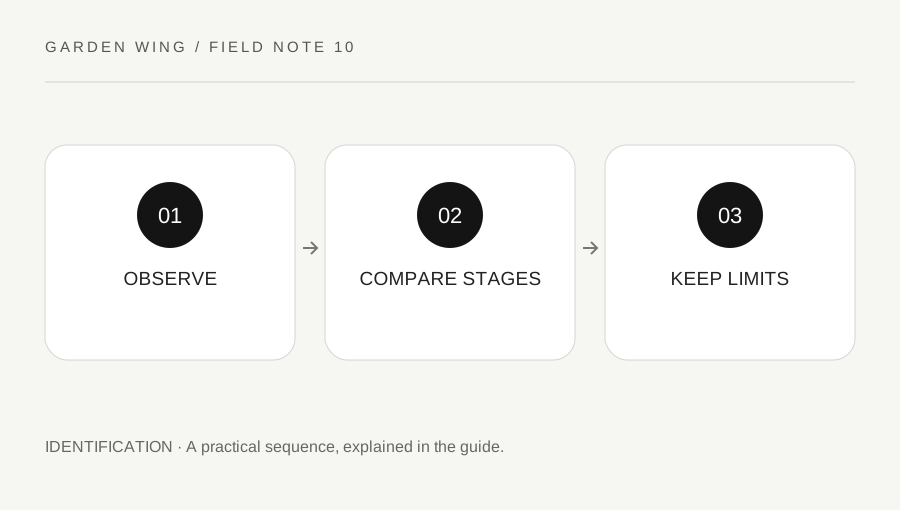
Original explanatory diagram. Numerical examples in this guide illustrate the reasoning; they are not a claim of hands-on testing.
Avoid the adult-male default
Many introductory pictures emphasize a brightly marked adult. Real garden observations include females, juveniles, worn feathers and seasonal appearances. If a bird fails the adult image, do not immediately conclude that it must be a different species. Compare the full reference gallery and descriptions.
Write the visible difference specifically: mottled chest, pale bill edge, shorter-looking tail or duller head marking. Do not label every untidy feather as evidence of youth. Wear, molt, posture and lighting can all alter appearance. An exact age often requires information unavailable to an ordinary garden observer.
The candidate finder uses broad selected colors and does not model every age stage. If a juvenile has a different pattern from its adult counterpart, a strict color filter may remove the correct species. Relax uncertain filters and return to the complete regional reference.
Use two robin examples to expose the assumption
A young European Robin does not display the familiar adult orange face and breast in the same way. A juvenile American Robin can show a spotted appearance rather than the relatively plain warm-colored underparts that beginners associate with adults. The shared common name does not make these the same species or the same identification task.
Read the reference for the correct country and compare shape as well as plumage. A juvenile-looking bird near an adult may provide context, but proximity alone does not confirm parentage or species. Keep the observation to what can be supported from the view.
For an illustrative note, write “small mottled bird in UK hedge, adult robin nearby; species uncertain; bill and face not fully seen.” The nearby adult is included as context without turning it into proof.
Observe behavior without intervening
A young bird may beg, follow another bird or remain partly hidden. Watch quietly from a distance and avoid making repeated approaches to see whether an adult returns. Your presence can change the behavior you are trying to interpret. A temporary absence of a parent from view does not establish abandonment.
If you encounter a bird that may be injured or in immediate danger, consult a local wildlife rescue authority's current guidance. This identification article does not supply handling or treatment instructions. Keep pets and people away while obtaining appropriate advice.
Do not feed a young wild bird based on an assumed species or age from a website. The purpose of the notebook is observation, not intervention. Record the location broadly and avoid sharing a precise nest or vulnerable bird location publicly.
Build an age-aware comparison note
Use four headings: visible marks, behavior, candidate species and unresolved questions. Under visible marks, include only features actually seen. Under behavior, describe actions rather than motives: “opened bill repeatedly while another bird approached” is stronger than “was starving.” Under unresolved questions, note the missing view or stage comparison.
Review the source gallery after the session, not while repeatedly moving toward the bird. If a candidate fits the juvenile description but the local range does not, keep searching. One matching age-related feature cannot override a major geographical conflict.
Finish with a tentative conclusion at the supported level, such as “possible juvenile thrush” rather than an exact species and age in days. Over time, comparing familiar adults with younger appearances in the same patch can improve recognition, but keep each record grounded in its own evidence and viewing conditions.
A practical checklist
Tick items for your own use. This checklist is saved only in this browser.
Questions that come up
Does a short tail prove a bird is a juvenile?
No. Species shape, viewing angle, damage and other factors can affect tail appearance. Compare several features and the complete reference.
Does a young bird alone mean it is abandoned?
No. A parent may be out of view. Avoid repeated approaches and consult local wildlife guidance if you have a welfare concern.
Can the tool identify every juvenile plumage?
No. Its broad filters and small dataset are a starting shortlist. Juvenile and seasonal appearances require a fuller field guide.
References & scope
Background references checked on 18 October 2026. The examples and practice exercises are original editorial explanations, not copied procedures or professional advice.
- Cornell Lab: All About Birds identification guide
- Cornell Lab: bird feeder cleaning
- RSPB: bird identification guide
- RSPB: current garden bird health guidance
- RSPB: current feeding advice
- Cornell Lab: American Robin
- RSPB: Robin
- RSPB: Blackbird
- American Birding Association: Code of Birding Ethics
- RSPB: bird-bath guidance
- Cornell Lab: preventing bird-window collisions
- BTO: identification resources
- RSPB: Starling
- Cornell Lab: finding a baby bird
- RSPB: injured birds and local help