US Feeder Comparison: A Finch Candidate or a Sparrow Candidate?
Small brown feeder birds deserve more than a quick family label. Compare streaking, face pattern, bill and regional possibilities, and avoid assuming that every individual matches an adult male photograph.
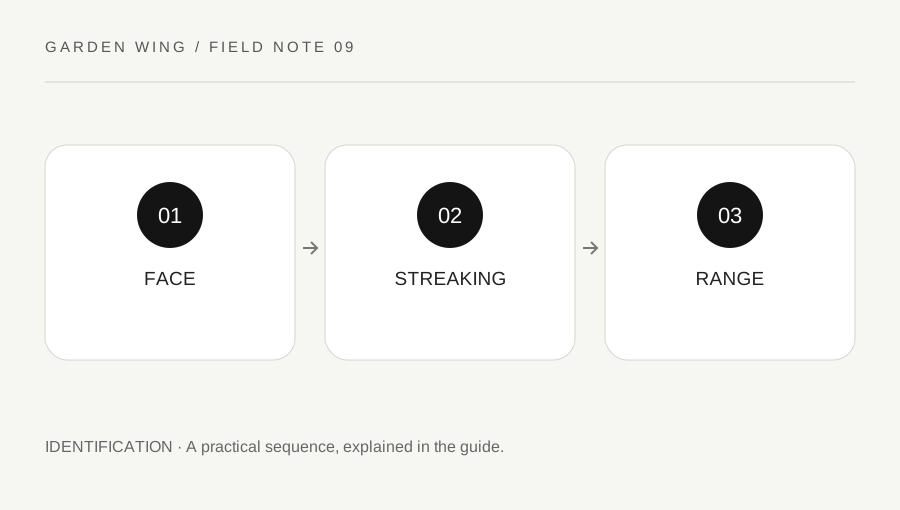
Original explanatory diagram. Numerical examples in this guide illustrate the reasoning; they are not a claim of hands-on testing.
Start with an unlabelled description
Record the bird's approximate size, bill profile, face markings and underside pattern. Write whether the breast was clearly streaked, apparently plain or not visible. A statement such as “small brown bird with a thick bill and streaked chest” is a useful beginning but still leaves several species possible.
Feeder use does not distinguish finches from sparrows. Many different birds take advantage of concentrated food. Also avoid assuming that a red-marked bird and a brown bird beside it must be different species; male and female appearances can differ. Conversely, proximity does not prove that two similar birds are the same species.
Watch each bird long enough to obtain a few independent features if it remains comfortably visible. Do not repeatedly approach or rearrange the food to produce a preferred view.
Compare House Finch and House Sparrow carefully
The House Finch reference provides examples of streaked brown underparts and adult male red coloration on parts of the head and chest. A female lacks that red. House Sparrow comparisons emphasize a different head and face pattern, with sex and age affecting what is visible. Use complete reference pages rather than treating these brief descriptions as a complete key.
Write a two-column comparison: observations on one side, expected candidate features on the other. A visible conflict is useful. If the face was hidden, leave the row unanswered rather than marking it as agreement. Some other finches and sparrows can share parts of this pattern, so two candidates are a learning exercise rather than the entire US possibility set.
Check the exact state or region and season on the reference map. A country-level tool cannot supply that local range test.
Keep light and posture in the record
A bird in shadow can conceal red, buff or gray patches. Reflected light from nearby objects may tint a pale surface, and fluffed feathers can make a narrow bird seem rounder. Note whether the observation was backlit, through tinted glass or partly blocked by feeder hardware.
An illustrative record might read “brown bird at feeder, chest streaking clear, face hidden behind port; possible House Finch, not confirmed.” That is more informative than assigning the candidate as a certainty and deleting the viewing limitation.
If several birds move rapidly, follow one individual only while you can do so reliably. A head mark from one bird and a wing mark from another should not be combined into an invented composite. Pause and reset the description when you lose track, even if the resulting note contains fewer features.
Choose a useful next observation
Select one feature that would distinguish the remaining candidates: a clearer face pattern, the distribution of chest streaking or the shape and color of the bill. Read the relevant source before the next session so that you know where to look. Learning a feature is more effective than trying to memorize every image on a page.
Use the candidate finder with only the fields you genuinely observed. If adding brown plus small plus feeder returns several birds, that is an honest reflection of broad filters. The output is not a probability ranking and should not be read as such.
Finish by keeping the reference link and the reason for your tentative label. Later confirmation can be added as a separate note. A detailed unresolved observation can become useful evidence; an unexplained confident name is much harder to review or correct after the encounter has faded from memory.
A practical checklist
Tick items for your own use. This checklist is saved only in this browser.
Questions that come up
Does the tool distinguish every North American sparrow?
No. It contains a small educational selection. Use a complete regional field guide when the shortlist does not fit.
Does no visible red rule out House Finch?
No. Females and some other plumages do not show the adult male red pattern. Use several features.
Why keep an uncertain label?
It preserves what was actually supported. You can add a later correction or confirmation without turning a brief partial view into a false certainty.
References & scope
Background references checked on 18 October 2026. The examples and practice exercises are original editorial explanations, not copied procedures or professional advice.
- Cornell Lab: All About Birds identification guide
- Cornell Lab: bird feeder cleaning
- RSPB: bird identification guide
- RSPB: current garden bird health guidance
- RSPB: current feeding advice
- Cornell Lab: American Robin
- RSPB: Robin
- RSPB: Blackbird
- American Birding Association: Code of Birding Ethics
- RSPB: bird-bath guidance
- Cornell Lab: preventing bird-window collisions
- BTO: identification resources
- RSPB: Starling
- Cornell Lab: finding a baby bird
- RSPB: injured birds and local help