Similar Garden Birds: Compare Shape, Pattern and Behavior
One bright patch rarely settles an identification. Compare a small set of visible features, then test the candidate against region, season and the limits of your view.
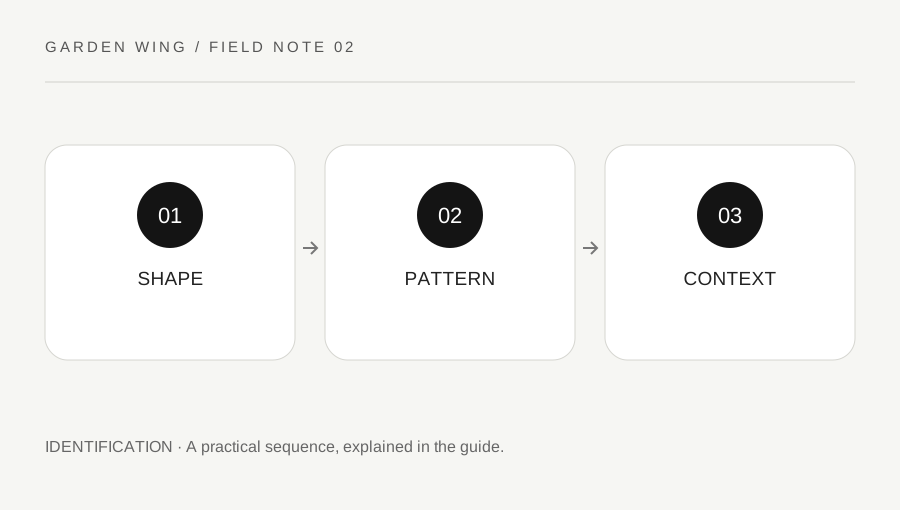
Original explanatory diagram. Numerical examples in this guide illustrate the reasoning; they are not a claim of hands-on testing.
Begin with structure rather than a favorite color
Describe the bird's outline while it is still visible. Is the body rounded or slender? Is the tail long relative to the body? Is the bill thick and conical or narrow and pointed? A brief silhouette can preserve these clues even when backlighting makes the colors unreliable. Use a familiar local bird as a rough size reference instead of guessing an exact length at a distance.
Posture changes the outline. A bird stretching upward can look slimmer than the same individual fluffed against cold weather. Distance also distorts comparisons between birds on different branches. Record the uncertainty: “about sparrow-sized, seen alone” is more defensible than “exactly fourteen centimeters.” The candidate finder deliberately uses broad overlapping size classes rather than precise measurements.
Locate a color patch on the body
Replace “yellow bird” with a more specific description such as “yellow belly, dark head, pale cheek.” Ask whether the visible color belongs to the chest, wing, head or rump. A small patch can be more useful than the overall impression, especially when a bird is partly hidden behind leaves.
In UK gardens, compare Blue Tit and Great Tit references using head pattern, body proportions and the dark central belly marking, rather than deciding from yellow underparts alone. In North American gardens, a red patch can suggest several different candidates, depending on its location and the bird's shape. Review both sexes and immature plumages on the source page. A picture of one adult male is not a complete description of the species.
Use names with geographical care
An American Robin is a larger thrush with different proportions from the smaller robin familiar in British gardens. Seeing an orange breast does not make the two interchangeable. Write the full common name and region in your notes, especially when reading an international website. Reference pages are more useful when their location assumptions match your own patch.
The same caution applies to “blackbird,” “sparrow” and “robin” in casual conversation. A common descriptive name may cover different species in different countries. If the reference includes a scientific name, preserve it when you need to distinguish similarly named birds. Do not use the shortlist as proof that a candidate is present throughout the entire selected country; check its documented range for the actual location.
Let behavior narrow, rather than prove, the answer
Record whether the bird walks, hops, clings to a trunk, feeds beneath a hedge or visits a hanging feeder. These behaviors help choose what to compare next. They are not exclusive species labels: many birds use more than one setting, and a bird may behave differently when disturbed or when a food source changes.
Build a two-column comparison for two candidates. In the first column, list the observed bill, head pattern, tail and movement. In the second, write the feature expected from each reference. Leave a row blank if you did not see it. A missing observation is not evidence against a species. A clearly conflicting feature is a reason to reconsider the candidate or your description.
Keep a useful unresolved record
Suppose a UK garden bird looked brown, moved on the ground and had a slim bill. Those observations alone leave several possibilities. A confident label from one distant glimpse would conceal the uncertainty. Instead, note the size relative to a known bird, whether the underside was plain or spotted, and whether the face had a clear marking. Seek another ordinary view without pursuing it.
Later, check the candidate against the complete observation rather than selecting the most attractive matching photograph. If it remains unresolved, save “unidentified garden bird” with the field marks. Learning includes knowing when the available evidence is insufficient. Over time, a collection of careful comparisons teaches recurring local patterns more effectively than a species list that contains several guesses you can no longer explain.
A practical checklist
Tick items for your own use. This checklist is saved only in this browser.
Questions that come up
Does the top tool result mean the identification is confirmed?
No. Results are an unranked educational shortlist matching your broad filters. Compare the linked species descriptions, range and multiple field marks.
Can juveniles look unlike adults?
Yes. Young birds and seasonal plumages can differ substantially. Use reference images and descriptions for the relevant life stage.
Why did adding a color remove the bird I expected?
The small dataset uses selected broad visible colors, not every variation. Relax one uncertain filter and compare the full source description instead of forcing a match.
References & scope
Background references checked on 18 October 2026. The examples and practice exercises are original editorial explanations, not copied procedures or professional advice.
- Cornell Lab: All About Birds identification guide
- Cornell Lab: bird feeder cleaning
- RSPB: bird identification guide
- RSPB: current garden bird health guidance
- RSPB: current feeding advice
- Cornell Lab: American Robin
- RSPB: Robin
- RSPB: Blackbird
- American Birding Association: Code of Birding Ethics
- RSPB: bird-bath guidance
- Cornell Lab: preventing bird-window collisions
- BTO: identification resources
- RSPB: Starling
- Cornell Lab: finding a baby bird
- RSPB: injured birds and local help